

HVAC companies do not lose leads only because the phone rings too much. They lose leads because the phone rings at the wrong time.
A homeowner’s AC stops cooling after dinner. A property manager notices a furnace problem before business hours. A commercial customer needs an answer while your office person is already handling another call. If that caller reaches voicemail, they usually do not wait politely. They call the next HVAC company.
That is where an AI receptionist becomes useful. For an HVAC business, it is not just a chatbot or a phone menu. The right AI receptionist answers quickly, asks the right questions, captures the job details, books or routes the request, and keeps the lead moving inside your CRM for HVAC companies.
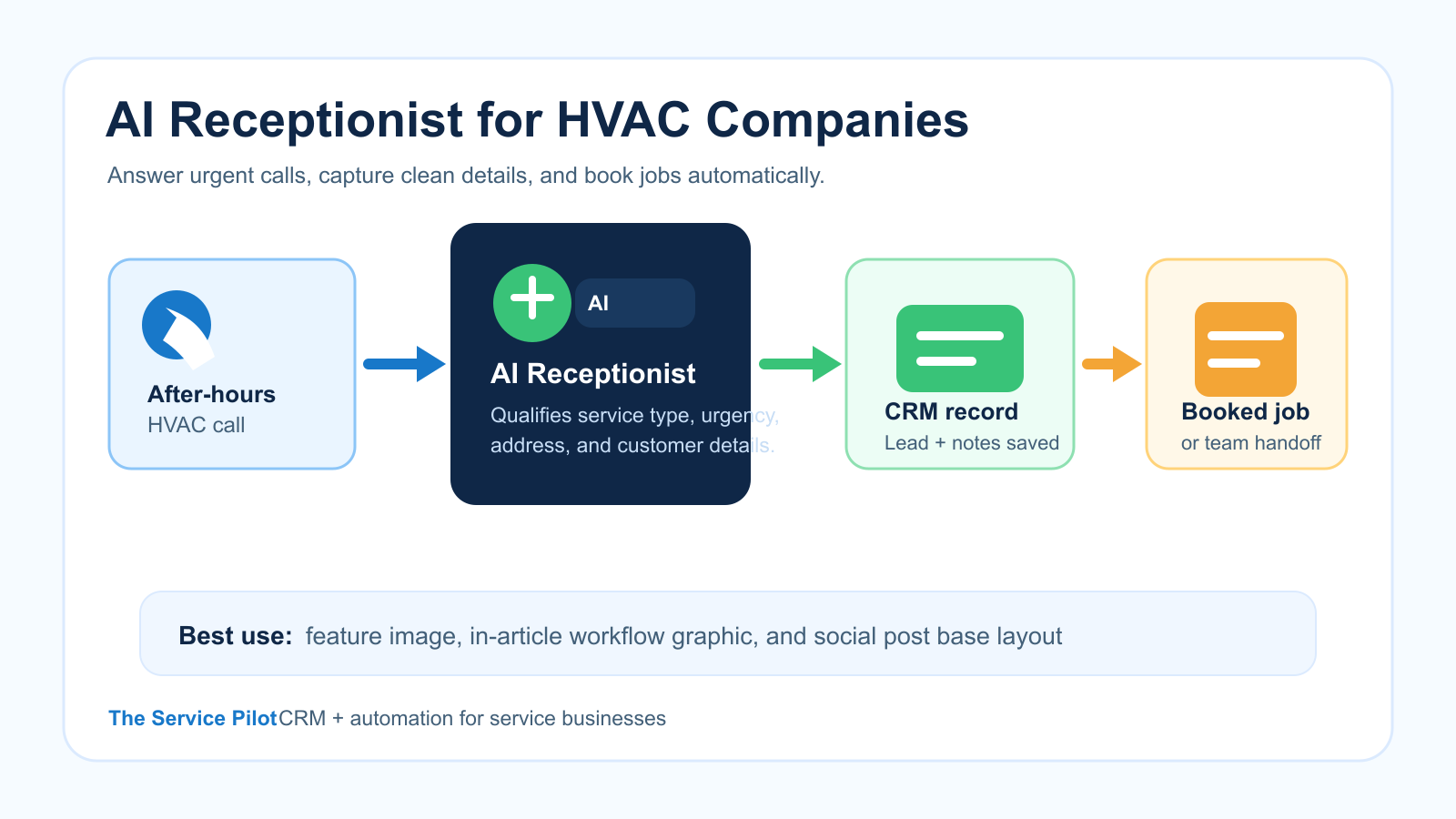
The goal is simple: fewer missed calls, cleaner lead records, faster follow-up, and more booked HVAC jobs without hiring another full-time office person.
Why HVAC Companies Need Faster Call Handling
HVAC buyers often have urgency built into the request. Cooling, heating, indoor air quality, maintenance plans, tune-ups, estimates, and emergency service calls all create time-sensitive conversations.
Common call-handling problems include:
- Calls missed while technicians are in the field
- After-hours leads going to voicemail
- Office staff taking one call while another call is abandoned
- Incomplete lead notes
- No consistent follow-up after an estimate request
- Emergency calls mixed together with routine maintenance questions
- Manual scheduling that depends on someone checking texts, email, voicemail, and website forms separately
Even strong HVAC companies can leak revenue when those pieces are disconnected.
An AI receptionist helps by making the first response immediate. It can greet the customer, collect the basics, identify the type of request, and push the conversation toward a scheduled appointment, estimate, or team handoff.
What an AI Receptionist Can Do for an HVAC Business
A useful AI receptionist for HVAC is not just an answering service. It should understand the workflow around service calls, estimates, maintenance plans, emergency requests, and follow-up.
For an HVAC company, the AI receptionist can:
- Answer calls 24/7, including nights, weekends, and peak-season overflow
- Capture the customer’s name, phone number, address, system type, and service concern
- Ask whether the issue is cooling, heating, thermostat, air quality, maintenance, replacement, or emergency service
- Text customers when they do not answer or abandon the call
- Route urgent requests to the right team member
- Book appointments when calendar rules are available
- Create or update contacts in the CRM
- Trigger follow-up sequences for unscheduled estimate requests
- Keep conversation history in one place
The strongest setup connects the receptionist directly to the CRM. That way, the call does not become another disconnected note. It becomes a lead, task, appointment, pipeline item, or follow-up workflow.
AI Receptionist vs missed-call text back
Missed-call text back is useful, but it is only one layer of the system.
If someone calls and no one answers, a text-back workflow can reply automatically with a message like, “Sorry we missed you. How can we help?” That is better than silence.
An AI receptionist goes further. It can answer the call before it becomes a missed call, hold a natural conversation, qualify the request, collect the details, and move the lead toward the next step.
For HVAC companies, that matters because the caller may be comparing speed, confidence, and professionalism in real time. If one company answers immediately and another sends a delayed text, the first company often has the advantage.
The best approach is not always either/or. Use AI answering for live call coverage and use missed-call text back as a backup layer when a call still slips through.
The HVAC Follow-Up Problem AI Can Fix
Many HVAC companies think of missed calls first, but follow-up is just as important.
Not every call turns into an appointment right away. Some homeowners want a replacement estimate. Some property managers need approval. Some maintenance-plan leads ask questions and then disappear. Some emergency callers book with whoever responds first.
An AI-powered CRM workflow can keep those opportunities from going cold.
Examples:
- If a replacement estimate lead does not book, send a same-day follow-up text.
- If a maintenance-plan lead asks for pricing, create a pipeline opportunity and reminder.
- If an after-hours emergency call is captured, notify the on-call person and log the conversation.
- If a customer books a tune-up, trigger confirmation and reminder messages.
- If a job is completed, trigger a review request.
This is where the CRM matters. The AI receptionist should not be isolated from scheduling, pipeline management, review requests, and reporting. It should feed the operating system that runs the business.
What HVAC Companies Should Look For
When comparing AI receptionist tools, HVAC companies should look beyond “answers calls.” The operational fit matters more than the novelty of the voice.
Look for:
- CRM integration, not just call transcripts
- SMS follow-up after calls and estimates
- Calendar or scheduling workflow support
- Lead qualification questions that match HVAC work
- Human handoff options for urgent or sensitive calls
- Conversation history stored on the contact record
- Clear pricing and usage rules
- Mobile access for owners, dispatchers, and field teams
- Review and reputation workflows after completed jobs
If the tool answers calls but leaves your team manually copying notes into another system, it only solves part of the problem.
How The Service Pilot Fits
The Service Pilot is built for service businesses that need CRM, quoting, scheduling, follow-up, payments, reviews, and automation in one workflow.
For HVAC companies, that means the AI receptionist can sit inside a broader operating system instead of becoming another disconnected app. Calls, texts, leads, booked jobs, follow-up reminders, and customer history can all support the same customer journey.
That is the real advantage: the AI does not just talk to the customer. It helps the business act on the conversation.
FAQ
Can an AI receptionist handle HVAC emergency calls?
Yes, an AI receptionist can capture emergency call details, ask qualifying questions, and notify the right person. For true emergencies or sensitive situations, the workflow should include a human handoff path.
Does an AI receptionist replace office staff?
Not always. Many HVAC companies use it to cover after-hours calls, overflow calls, and repetitive lead capture. It can reduce the workload on office staff while keeping humans involved for judgment-heavy conversations.
Is missed-call text back enough for HVAC companies?
Missed-call text back is a strong backup, but it starts after the call is missed. An AI receptionist can answer immediately, qualify the caller, and move the lead forward before the customer calls a competitor.
Should the AI receptionist connect to the CRM?
Yes. CRM connection is important because the value is not just answering the call. The value is creating a usable lead record, triggering follow-up, booking the job, and keeping the customer’s history organized.
What HVAC workflows should be automated first?
Start with missed calls, after-hours calls, estimate follow-up, appointment confirmations, review requests, and maintenance-plan reminders. Those workflows usually create quick operational value without changing the entire business at once.
Final Takeaway
HVAC companies win more work when they respond quickly, collect clean information, and follow up consistently.
An AI receptionist helps make that happen around the clock. When it is connected to the CRM, scheduling, and follow-up system, it becomes more than a phone tool. It becomes part of the revenue engine.
If your HVAC business is still relying on voicemail, scattered texts, and manual follow-up, The Service Pilot can help you build a cleaner system for capturing calls, booking jobs, and staying organized.
Start free with The Service Pilot, or watch an instant demo to see how the AI receptionist and CRM workflows fit together.
Connect HVAC calls to CRM follow-up
An AI receptionist for HVAC companies is most valuable when every after-hours call, emergency request, maintenance-plan question, and replacement lead flows into the same customer pipeline. That gives the owner or dispatcher a clear next step instead of another voicemail or loose text thread.
The Service Pilot connects HVAC lead intake with service business CRM, missed-call text-back software for service businesses, quote follow-up software, and review automation for contractors so more calls become booked jobs and more completed jobs create reputation momentum.
HVAC CRM workflow examples
- Emergency no-cool or no-heat calls can create a customer record, tag the job type, and trigger a fast response path.
- Estimate requests for replacements, repairs, duct work, and maintenance plans can move into a visible quote follow-up pipeline.
- Completed HVAC jobs can trigger payment follow-up and review requests without depending on manual reminders.
For a broader CRM view, compare this HVAC-specific workflow with the contractor CRM page and the field service CRM for small businesses guide.
AI Receptionist Resource Hub
Use these buyer guides to compare pricing, ROI, human handoff, office workload, trade-specific intake, and guardrails before adding AI call coverage to a service business.
- AI Receptionist Pricing
- AI Receptionist ROI Calculator
- AI Receptionist vs Live Answering Service
- AI Receptionist vs Office Staff
- AI Receptionist Guardrails
- AI Receptionist Best Practices
- AI Receptionist for Contractors
- AI Receptionist for HVAC
- AI Receptionist for Plumbing
- AI Receptionist for Electricians
- AI Receptionist for Window Cleaning
- AI Receptionist for Pressure Washing
How HVAC AI receptionist workflows should connect to the CRM
An AI receptionist is strongest when it does not stop at answering the phone. For HVAC companies, the call details should move into CRM for HVAC companies with the customer’s service issue, urgency, appointment status, estimate stage, and follow-up history attached to one record.
That connection helps owners compare AI answering against broader contractor CRM software, missed-call text-back software, quote follow-up software, and review automation for contractors instead of treating each tool as a separate app.
Connect the call to the booking workflow
Answering the phone is only the first step. HVAC teams also need a consistent way to move qualified callers toward an appointment. The Service Pilot’s AI booking software for service businesses connects lead capture, job details, scheduling, and follow-up so urgent repair requests and planned maintenance inquiries do not stall between the first conversation and the calendar.