
Roofing CRM Software for Contractors
Roofing Leads Are Too Expensive to Track Loosely
Roofing companies usually pay a real cost to generate each opportunity. Leads may come from storm response, referrals, door knocking, Google, Facebook, insurance-related searches, yard signs, home shows, website forms, and past customers. When those leads are scattered across texts, inboxes, notebooks, spreadsheets, and sales reps’ phones, it becomes hard to know which jobs are moving and which ones are quietly going cold.
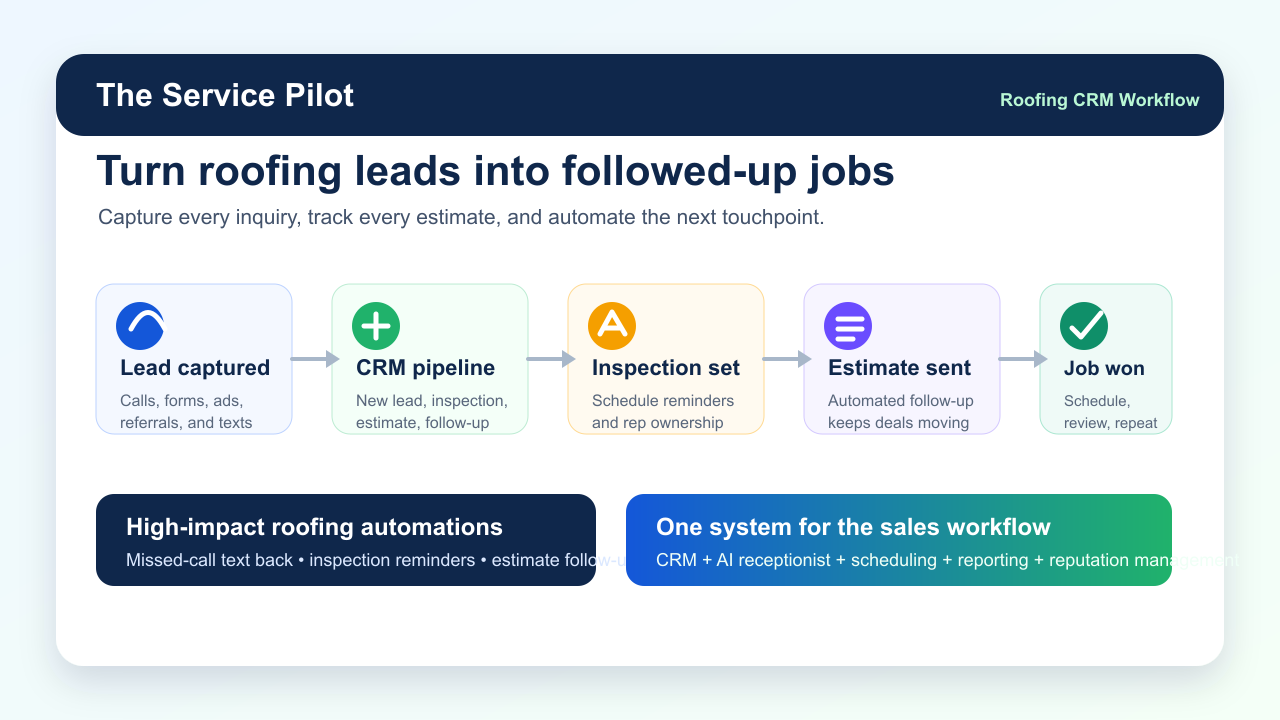
A CRM for roofing companies should give the owner and team one clear view of every opportunity. It should show who called, who needs an inspection, who received an estimate, who needs follow-up, who is waiting on scheduling, and who should be asked for a review after the job is complete.
The Service Pilot helps service businesses combine CRM, automation, missed-call response, scheduling, quote follow-up, review requests, reporting, and AI-powered lead conversion in one practical system.
Where Roofing Companies Lose Jobs
Most roofing teams do not lose work because they cannot install a roof. They lose work because the sales and communication process gets messy when demand spikes.
Related resources: service business automation features, The Service Pilot pricing, The Service Pilot FAQ, AI receptionist support, missed-call text back vs AI receptionist, field service CRM for small businesses, CRM for HVAC companies, CRM for plumbing companies.
Common gaps include:
- Storm leads coming in faster than the team can answer
- Missed calls while reps are in the field
- Inspection requests that are not assigned quickly
- Estimates sent once and never followed up
- Homeowners waiting for updates on scheduling or next steps
- No consistent handoff from sales to production
- Review requests forgotten after completed jobs
- Past customers and older estimates never reactivated
A roofing CRM should reduce those gaps by making the next action visible and automating the follow-up that busy teams often skip.
What a Roofing CRM Should Include
For a roofing company, a basic contact database is not enough. The CRM needs to support the real sales cycle from first contact through final review.
Important CRM features for roofers include:
- Lead capture from calls, forms, ads, messages, and referrals
- Pipeline stages for new lead, inspection scheduled, estimate sent, follow-up, job won, job scheduled, completed, invoiced, and review requested
- Missed-call text back so new inquiries receive an immediate response
- AI receptionist support for overflow calls and after-hours capture
- Estimate follow-up sequences for open proposals
- Appointment reminders for inspections and consultations
- Customer notes and history for repeat property owners
- Review request automation after completed jobs
- Reporting on lead source, booked jobs, open estimates, and follow-up activity
- Mobile access for owners, sales reps, office staff, and field teams
The goal is not to add more admin work. The goal is to make the sales process easier to manage and harder to drop.
How The Service Pilot Helps Roofing Companies Follow Up Faster
The Service Pilot gives roofing companies a connected workflow for lead capture, CRM tracking, automation, communication, and reputation management.
Useful roofing workflows include:
- A missed call triggers an immediate text response
- A new roof lead is added to the CRM with source and contact details
- The lead moves into an inspection or estimate pipeline stage
- Follow-up messages go out when a homeowner has not replied
- Appointment reminders reduce missed inspections
- Completed jobs trigger review requests
- Older estimates can be reactivated before the season changes
- Managers can see which opportunities need attention
Roofing work often has a long decision cycle compared with smaller service jobs. Consistent follow-up keeps the company visible while the homeowner compares options, waits on insurance details, or talks through the project with family.
Example Roofing CRM Pipeline
A simple roofing pipeline can start with these stages:
- New lead
- Needs qualification
- Inspection scheduled
- Estimate requested
- Estimate sent
- Follow-up needed
- Job won
- Production scheduled
- Job completed
- Invoice sent
- Review requested
- Re-service or referral opportunity
Each stage should have a clear owner and next step. If an estimate sits for too long, the CRM should remind the team to follow up. If a job is completed, the system should request a review. If a past customer may need gutter, inspection, or maintenance communication, the record should be easy to find.
Roofing CRM Automation Ideas
Roofing companies can start with practical automations that protect revenue without overcomplicating the business.
Good starting automations include:
- Missed-call text back for all inbound roofing calls
- Inspection confirmation after scheduling
- Day-before inspection reminder
- Estimate follow-up after 24 hours, 72 hours, and 7 days
- Production schedule update messages
- Post-job review request
- Older estimate reactivation sequence
- Past customer referral request
These workflows help the company respond quickly, stay organized, and keep prospects engaged without depending on memory alone.
FAQ
What is the best CRM for roofing companies?
The best CRM for a roofing company is one that tracks leads, inspections, estimates, follow-up, scheduling, customer communication, and reviews in one workflow. A generic contact list usually is not enough for roofing teams that manage higher-ticket jobs and longer sales cycles.
Can a CRM help roofing companies follow up on estimates?
Yes. Estimate follow-up is one of the strongest roofing CRM use cases. Automated reminders can help the company stay visible after the proposal is sent without forcing reps or office staff to manually chase every open estimate.
Should roofers use missed-call text back?
Yes. Missed-call text back is useful for roofing companies because many leads come in while reps are driving, inspecting properties, meeting homeowners, or managing active jobs. An immediate text response keeps the lead engaged before they call another contractor.
Does The Service Pilot replace roofing production software?
The Service Pilot is focused on CRM, automation, lead conversion, communication, marketing, reputation, and follow-up workflows for service businesses. Some roofing companies may use it as their main growth system, while others may use it alongside specialized production or estimating software.
CTA
If your roofing company is paying for leads but losing track of calls, inspections, estimates, and follow-up, The Service Pilot can help you build a cleaner CRM and automation workflow.
Start with missed-call text back, inspection reminders, estimate follow-up, review requests, and a visible roofing pipeline your team can use every day.
Connect roofing CRM to follow-up and review automation
A roofing CRM works best when it does more than store contact records. The same system should help the team answer new inquiries, track inspections, follow up on open estimates, schedule the next step, and request reviews once the job is complete.
The Service Pilot connects this CRM for roofing companies with missed-call text-back software for service businesses, AI receptionist workflows, and quote follow-up software so roofing leads have a clear path from first call to booked work.
Roofing teams can also connect their pipeline to a broader service business CRM guide, compare workflows on the contractor CRM page, and automate reputation touchpoints with review automation for contractors.
Roofing CRM lead recovery FAQ
Why do roofing companies need CRM follow-up?
Roofing leads often come from storm damage, leak calls, inspection requests, insurance questions, and homeowners comparing multiple contractors. A dedicated CRM for roofing companies should keep the lead source, roof issue, inspection notes, estimate stage, next follow-up, scheduled job, invoice, and review request visible in one workflow.
How should a roofing CRM handle missed calls?
Roofers are often on ladders, in inspections, driving between estimates, or talking with adjusters when new calls arrive. The Service Pilot can connect missed-call text-back software for service businesses and AI receptionist workflows to the same CRM pipeline so the homeowner gets a fast response and the contractor can still see the next step.
What automations matter after a roofing estimate?
The strongest setup connects quote follow-up software, service business CRM, contractor CRM workflows, and review automation for contractors so roofing companies can move from first call to inspection to estimate follow-up to reputation growth without relying on memory.
Roofing CRM should connect AI booking, estimates, and follow-up
Roofing leads often start as a missed call, inspection request, storm-damage question, or estimate conversation. A roofing CRM is stronger when the same record shows how the lead was captured, whether the inspection was booked, when the estimate was sent, and which follow-up step is due next.
The Service Pilot connects AI booking software for service businesses, quote follow-up software, contractor CRM software, missed-call text-back software, and review automation for contractors so roofing teams can keep expensive leads from drifting between the first call, the estimate, the booked job, and the review request.