
SEO for Sugar Land Service Businesses
Sugar Land customers often compare reviews, proof and service details carefully. We help businesses show up locally and present a trustworthy next step.
A trust-heavy market
Visibility gets you considered; credibility earns the call.
Established neighborhoods such as First Colony, Telfair and Riverstone include homeowners who research providers and compare recent reviews. A Houston-only presence can miss Fort Bend searches, while companies from Missouri City, Stafford and Richmond compete for many of the same map positions.
What we build
Local relevance without cloned city pages
- Distinct service content for Sugar Land and nearby Fort Bend markets the company actually serves.
- A review request and response process focused on consistent, truthful customer feedback.
- Helpful answers about permits, community rules or preparation when they genuinely apply to the trade.
- Consistent citations and legitimate local links based on real memberships, sponsorships or relationships.
Local SEO in Sugar Land
How we approach SEO for Sugar Land and Fort Bend businesses
Local SEO for a connected Fort Bend market
Sugar Land customers do not always search within one city boundary. A service company may work along the US-59 corridor, around Highway 6, in Missouri City, or in Stafford, but its real coverage depends on crew routes, job type, and operating capacity. Useful local SEO begins by documenting that genuine coverage instead of adding place names to a generic page.
We review the services the company actually provides, where it can reliably deliver them, and which existing pages already earn impressions. Then we make those facts easier for customers and search engines to understand. The goal is a clear answer to three buyer questions: do you perform this service, do you serve my location, and what is the next step?
Build content around real services and buyer questions
Different service businesses need different information. An HVAC company may need to separate repair, maintenance, and replacement. A plumber may need clear emergency availability and service limitations. A landscaper may distinguish recurring maintenance, drainage, irrigation, and installation. A commercial provider may need to explain site walks, insurance requirements, scheduling, and proposal inputs.
Those distinctions are useful because they reflect real buying decisions. They should not become dozens of thin pages. Before recommending a new page, we check whether an existing service page can be strengthened with clearer scope, genuine photographs, customer questions, and an accurate service area. One complete page is usually safer and more useful than several near-duplicates.
Make local signals accurate
The website, structured data, citations, and an eligible Google Business Profile should describe the same business. We check the public name, phone, hours, categories, website destination, and service area for conflicts. We also confirm that important service pages are crawlable, canonical, and connected through useful internal links.
We do not recommend virtual offices, false addresses, keyword-stuffed profile names, or duplicate profiles. Membership in the Fort Bend Chamber of Commerce, Central Fort Bend Chamber, or another organization can be mentioned only after the business has actually joined and the fact is verified. Supplier or partner relationships also require permission and must not be presented as endorsements.
Reflect how the area actually operates
Sugar Land, Missouri City, and Stafford sit close together, but route time and service fit still matter. A business may serve neighborhoods on both sides of Highway 6 while limiting distant or low-value jobs. A commercial contractor may follow the US-59 corridor, while a residential provider may organize recurring routes by day.
The site can explain genuine scheduling boundaries, minimums, service frequencies, and coverage without pretending every nearby community is identical. It can also answer local questions that customers really ask, such as storm-related availability, heat and humidity concerns, access to gated communities, or whether a commercial estimate requires an on-site visit. Any such detail must come from the business, not from an SEO template.
Turn visibility into a working inquiry path
A ranking does not help if a customer reaches a broken link or unclear offer. We review the rendered mobile page, headings, contact actions, forms, and the path from a location page to the correct service. Pricing, booking, and conversion flows that already work stay unchanged unless you approve a specific fix.
The smallest useful improvement might be fixing one broken internal link, clarifying a service description, or adding genuine proof. Larger changes should follow evidence, preserve what already works, and have a tested rollback path.
Measure each outcome honestly
Search impressions mean a page appeared in results. Clicks mean visits from search. Calls and forms are inquiries. Booked jobs and revenue are later business outcomes. SEO reporting should not treat one as proof of another.
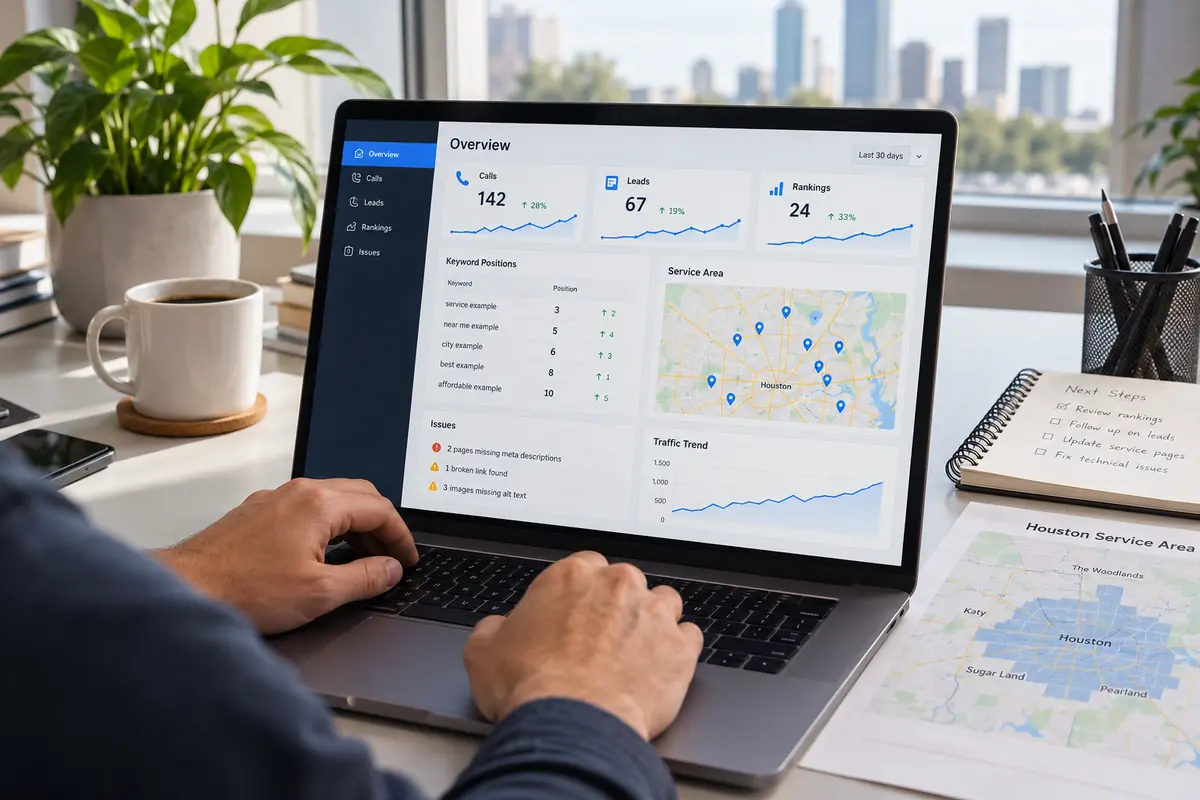
We start with a dated baseline, document approved work, and compare matched periods. Rankings vary by location, device, time, and competition, so a single spot check is not a result. Clients receive regular reports and a live daily dashboard inside their Service Pilot account.
Frequently asked questions
Clear answers before you start
Do reviews matter more in Sugar Land?
Should we create a page for every neighborhood?
Do I need separate pages for Sugar Land, Missouri City, and Stafford?
Can a service-area business rank in Sugar Land without an office there?
What should a Fort Bend service company measure from SEO?
Realistic examples
Plan around the Sugar Land market
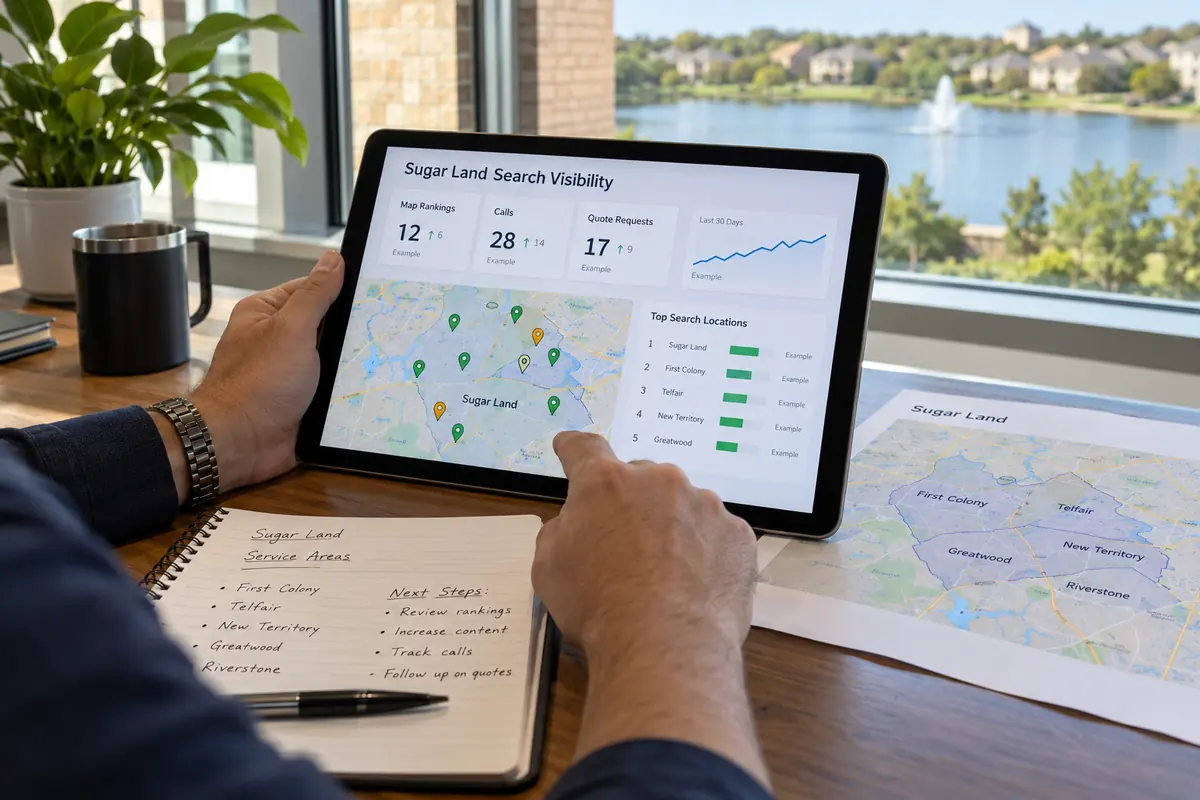
Measure visibility and demand across the communities the business truly serves.
Your next step
See where your business stands in local search.
We’ll show you the clearest opportunities first and explain what it will take to compete.